WHAT ARE THE NIESSING COLORS?
The Niessing Colors are the precious metal colors developed by the Niessing manufactory. Niessing has been alloying gold and platinum in its own workshop in Vreden since 1873 and has created more than 40 gold colors along the way — from light yellow with a green undertone to deep red and warm gray. These are not coatings or surface treatments, but distinct alloys: the color is in the material itself and runs through the entire piece of jewelry.
HOW MANY GOLD COLORS DOES NIESSING OFFER?
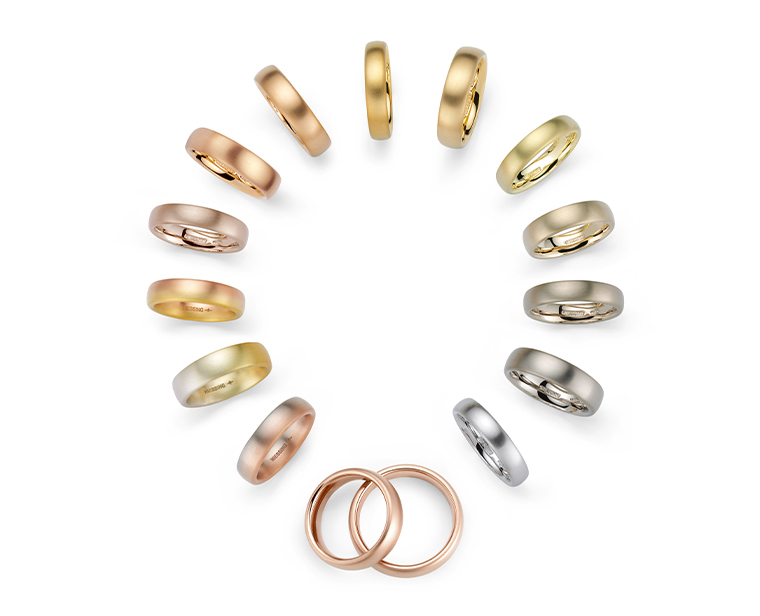
More than 40 gold colors have been created at the manufactory in Vreden. Some of them form the permanent color range available for wedding rings, engagement rings and jewelry. With Niessing Rosewood and Niessing Ivory, Niessing completed the color circle in gold in 2015 — the color spectrum thus encompasses all areas of the circle and is unique worldwide in its breadth.
WHICH NIESSING COLORS ARE AVAILABLE?
The color range includes the plain gold tones Ivory, Spring Green, Classic Yellow, Warm Yellow, Fine Rose, Classic Red, Rosewood, Sand Gray and Fine Gray, as well as the Anniversary Color Supla Grenadine. They are complemented by the precious metals Platinum and Palladium and the color gradients Niessing aura®, Iris and Solaris, in which a multitude of color nuances flow seamlessly into one another. In brief: Ivory combines the warmth of yellow gold with the clarity of gray gold. Spring Green is a light yellow gold with a hint of green. Classic Yellow is classic golden yellow, while Warm Yellow comes closest to pure gold. Fine Rose is a golden yellow with a hint of red, while Classic Red is as red as only gold can be. Rosewood shifts between reddish, violet and brown tones. Sand Gray is a warm gray gold, while Fine Gray is pure understatement with an almost imperceptible golden shimmer in the white.
WHICH NIESSING COLOR CORRESPONDS TO CLASSIC YELLOW GOLD?
For classic yellow gold, Niessing offers two colors. Classic Yellow is the original warm and luminous golden yellow — the shade most people picture when they think of yellow gold. Warm Yellow goes one step further: it is the purest gold tone in the range, a deep yellow with a touch of orange, and comes closest to pure gold. Those who prefer something lighter and fresher will find a yellow gold with a subtle green undertone in Spring Green, and an ivory-colored tone between light yellow, white and light green in Ivory.
ARE NIESSING WEDDING RINGS AVAILABLE IN WHITE GOLD?
At Niessing, what is commonly referred to as white gold is called Fine Gray. It is a white tone with a very subtle, almost hidden golden shimmer — just enough to add warmth, making it noticeably more vibrant than a purely white ring. Those who prefer more color in the gray can choose Sand Gray: a gray gold as soft and warm as fine sand by the sea, surprisingly rich in color for a gray tone. Those who prefer a cool, clear white tone will find it in the precious metals Platinum and Palladium.
WHICH NIESSING COLORS ARE ROSE GOLD OR RED GOLD?
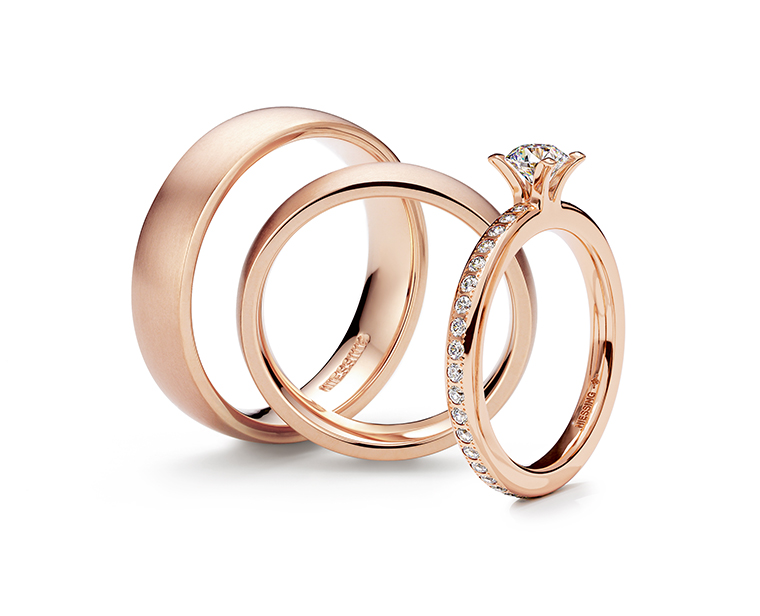
Four colors cover this spectrum. Fine Rose is a golden yellow with a hint of red and shimmers like a delicate rose blossom — the most understated of the four tones. Classic Red glows like a sunset: red yet unmistakably golden. Rosewood has a life of its own and, depending on the light, can appear reddish, almost violet, rose pink or distinctly brown. Finally, Supla Grenadine is a rose-colored, warmly shimmering gold with a proportion of platinum that gives it a strikingly bright radiance — the Niessing Anniversary Color that translates the iconic Niessing Grenadine of the brand lettering into precious metal.
WHAT ARE NIESSING AURA®, IRIS AND SOLARIS?
These are the color gradients in the Niessing range — alloys in which a multitude of colors flow seamlessly into one another without a visible dividing line. Niessing aura® was created in 2010 and transforms gold from soft red to fine gray. With Iris, pure silver meets pure gold, as cool white dissolves into warm yellow. Solaris combines red and yellow while allowing both colors to retain their character; the alloy received a Red Dot award in 2017. These gradients are therefore the most technically sophisticated form of the Niessing Colors and are unique in this form.
WHAT FINENESS DO NIESSING ALLOYS HAVE?
Every piece of gold jewelry is engraved with the abbreviation AU — from aurum, the Latin word for gold — and a number. This number indicates the proportion by weight of gold in the alloy, based on 1,000 parts. Niessing uses AU 1000 (fine gold), AU 900, AU 750 and, for some wedding rings, AU 585. For platinum, Platinum 950 (PT 950) and Platinum 600 (PT 600) are used; for palladium, Palladium 950 (PD 950). Niessing produces all of its alloys in-house to ensure consistent quality throughout.
ARE NIESSING RINGS NICKEL-FREE AND SUITABLE FOR SENSITIVE SKIN?
Niessing does not use nickel in its gold alloys, but palladium — a silvery-white precious metal from the platinum group that is pure, white and skin-friendly. Platinum is also well suited to sensitive skin. Since a ring is worn continuously and directly on the skin, the choice of alloying metal is not a minor detail, but a conscious decision by the manufactory.
WHICH MATERIAL IS MOST DURABLE FOR WEDDING RINGS: GOLD, PLATINUM OR PALLADIUM?
All three precious metals are made for everyday wear, but they behave differently. Platinum 950 is particularly tough: over the years it takes on the marks of wear without losing any significant amount of material — a platinum ring retains its weight over a long period of time. Palladium 950 is clear and cool gray-white and remains permanently color-stable without rhodium plating, so it does not require retreatment. With gold, hardness depends on fineness: AU 585 and AU 750 are more resistant than fine gold, which is soft as a pure metal. The right material therefore depends less on durability than on the desired color and the everyday life in which the ring will be worn.
WHAT IS NIESSING PALLADIUM AND HOW DOES IT DIFFER FROM PLATINUM?
With Palladium 950, Niessing has expanded its wedding ring range with another precious metal of distinctive character. Its color is a clear, cool gray-white and remains permanently stable without rhodium plating. In appearance, palladium resembles platinum — modern, minimalist and refined — but is priced below it, making it an attractive entry into the world of Niessing precious metals. Niessing Platinum, by contrast, has a naturally radiant, moon-white shimmer and is significantly heavier; it is particularly well suited for setting diamonds because its naturally white color allows a stone's fire to unfold to full effect.
DOES THE COLOR OF A NIESSING RING CHANGE OVER THE YEARS?
The color of the Niessing Colors is created within the alloy itself, not by a coating. It therefore runs throughout the material and cannot wear away. Palladium 950 remains permanently color-stable without rhodium plating. Platinum 950 develops its own surface over the years as it takes on the marks of wear, but it does not lose any significant amount of material. All Niessing alloys and Niessing Colors can be professionally refreshed.
WHERE ARE THE NIESSING COLORS MADE?
All alloys are created at the Niessing manufactory in Vreden in the Münsterland region — the place where goldsmith Hermann Niessing founded his workshop in 1873. The entire production process takes place under one roof: from melting the gold and platinum bars to the finished piece of jewelry. The design department in Düsseldorf and the workshop in Vreden work closely together on research and development. Niessing's ability to produce its own alloys is essential to achieving this color spectrum: it is not created from purchased materials, but through decades of in-house alloy development.
AS A LEADING SPECIALIST IN GOLD COLORS, NIESSING HAS A LONG HISTORY. WHEN WERE THE GOLD COLORS AND PLATINUM INTRODUCED?
The gold color Classic Yellow was introduced as early as 1873. In the 1950s, the gold colors Warm Yellow, Fine Rose and Classic Red followed. The color Supla (gold with a proportion of platinum) was patented in 1965. Niessing launched platinum in 1978, followed by the Iris color gradient in 1983. Sand Gray, Fine Gray and Spring Green were added in 1984. The Aura color gradient was introduced in 2010, followed by the gold alloys Rosewood and Ivory in 2015. The Solaris color gradient was launched in 2017, as were the silver-gold alloys Lava, Rose and Lime. Purple Gray and Peach Pink, two further distinctive gold colors, were created in 2018. Finally, the gold color Supla Grenadine was introduced in the anniversary year 2023.
HOW DO I FIND THE RIGHT NIESSING COLOR FOR ME?
Color looks different on a person than it does on a screen — skin tone, light and ring width all noticeably affect the impression. It is therefore worth trying the colors on directly in a Niessing Store or at a Niessing partner jeweler and comparing them side by side. Those deciding between two tones will find a third option in the Niessing aura®, Iris and Solaris color gradients, where two colors come together in one ring.